Phasmid Species
Diapherodes gigantea
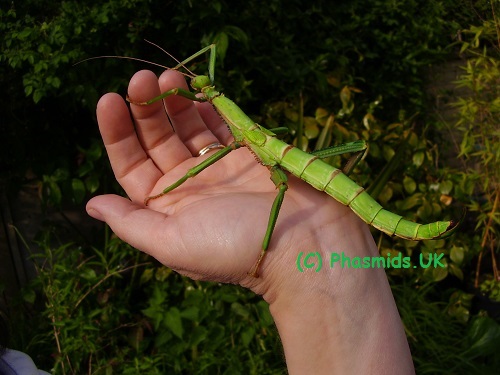
This is a popular and easy species that comes originally from Grenada. They are very spectacular, being a beautiful bright green colour. Females grow to about 16cm long, males are much smaller and thinner and fully winged.
They are also very 'tame', completely harmless and excellent for education and as pets, including for children.
They can be kept at room temperature in a cage that should be at least 40cm tall when they are large, to allow room for them to shed their skin (which all stick insects do by hanging upside down and 'falling' out of their old skin).
They feed on Eucalyptus gunnii, some other Eucalypts, Oak, or bramble. They will probably do best on a mixture of foodplants, particularly Eucalyptus and Oak.
This species needs adequate ventilation in the cage, they do not like to be too humid. Young nymphs are a bit more tolerant of humidity. They can be sprayed with water occasionally, but if you don't see them drinking after spraying they probably don't need it.
Adult females of this species are prolific egg layers. They lay hundreds of eggs, dozens per week from one female.
Heteropteryx dilatata
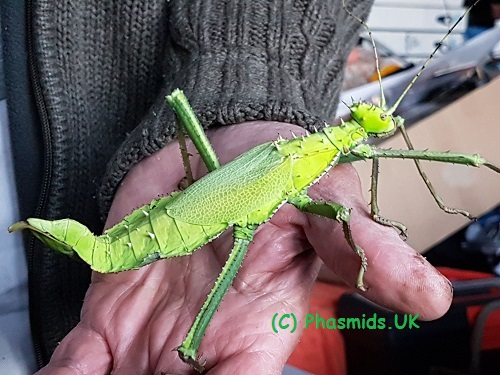
This is one of the bulkiest species of stick insect in the world, the females grow up to 25cm in length.
They also lay huge eggs, about 12mm long. Males are smaller and brown. Both sexes have small wings and cannot fly.
They need to be kept at least 20°C, but ideally 25-30°C, in high humidity.
The females are bright green and very impressive, being large they have big appetites. They feed on bramble, rose, raspberry, oak, ivy and Eucalyptus gunnii.
Both sexes are very aggressive, so they are not suitable for young children. They can pinch strongly with their spiny hind legs. They do this so fast it is difficult to avoid being hurt. However, they may give some warning, with a hissing sound made with their wings, and their defensive posture is to raise their back legs in the air, menacingly.
They need to be kept humid but with some ventilation. I spray them with water every day or so. They feed on bramble, rose, raspberry, oak, ivy and Eucalyptus gunnii.
Eggs are buried in the substrate that has to be provided on the floor of the cage, such as vermiculite.
They have to be kept damp and not be allowed to dry out, or they will die.
They can take a long time to hatch, maybe 6 to 14 months.
Peruphasma schultei

This species comes from the Cordillera del Condor in North Peru, it is said to come from an area of about 5 hectares, so this makes it extremely rare in the wild - unless it is ever discovered somewhere else! As it occurs at altitudes of 1200m to 1800m it does not require much heat, and room temperature is sufficient for its culture (18 - 24 Centigrade is recommended). I first imported the species in 2006 and have had the culture running continuously ever since. Its ease of breeding has meant that it is now widely distributed amongst phasmid breeders in the UK.
These stick insects feed on Schinus in the wild, but in the UK they do well on Privet and/or Lilac. I keep them in a small cylinder cage that has a section of netting on the lid for ventilation. They do not like to be kept too humid, I had one or two die after spraying with water when I first started keeping them. If you think that they may be too dry, try spraying lightly with a small amount of water onto the leaves. If they are thirsty you will see them drink from the droplets of water on the leaves. If they don't drink, they are humid enough and don't need spraying. If you use a very well ventilated cage, i.e. all netting, they may well need occasional light spraying.
If swapping these nymphs to lilac, please give them some privet as well, in case they don't like the change! I have found that they don't swap to lilac straight away, they need a while to get used to it. I give a mixture when possible so that they can choose what they want to eat. Remember that unlike privet, lilac loses its leaves in winter.
Nymphs of this species hide wherever they can, such as under fallen leaves on the floor of the cage - take care not to throw them away when cleaning them out! They are also very agile and can run away at an amazing speed, keep an eye on them. I have found one or two individuals around the house that have slipped away whilst cleaning them out!
Peruphasma belongs to a family of stick insects that includes some that spray a defensive irritating fluid from the thorax. Although they are weak sprayers, never hold them close to the eyes, and always let them walk onto you or off of you, never grab hold of them. The spray has a peculiar, slightly unpleasant smell, but it's only produced when they are alarmed. It's a good idea to wash your hands after handling them. I have found that one of my cats is very attracted to the smell, and was determined to try and eat one. After discouraging her many times, she managed to grab one, but the insect's defence chemical made her foam at the mouth and she dropped it. To my huge relief, she recovered shortly afterwards with no ill effects.
When they become adult, both sexes of Peruphasma have bright red wings, which they often display when walking around. I am not sure why they do this, I presume it is some kind of signal to other individuals. Their wings may also be used for flash warning to predators.
All stages seem to be very easy to rear, the adults live for several months and are prolific egg layers. The eggs are dropped to the floor of the cage, not buried or glued to objects. The eggs show a very good hatch rate.
Epidares nolimetangere
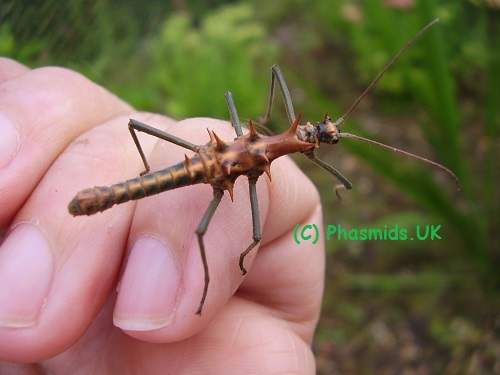
They are called 'Touch-me-not' by the locals in Sarawak where they originate because they have sharp spines, but are quite harmless.
This species is fairly small, females grow to about 4 to 5cm long, males are smaller at 3 to 4cm long.
I keep them at room temperature in a cylinder cage with a cloth lid held on with two rubber bands (in case one snaps!) to allow some air in, whilst maintaining some humidity. I spray them with water every few days. They do not like to be dry for any length of time, but are fairly tolerant of being dry for a few days. The only time I had any die was when the cage contents were very dry for several days when I was away, and some of the adult males and young nymphs died.
The cage I use is only 30cm high by 20cm across.
Their favourite foodplant seems to be bramble, but I also use rose. The literature states that they will also take oak and Pyracantha.
This species is good at trotting off when you are cleaning them out, so keep an eye on them! They will lull you into a false sense of security by remaining quite still, then when you think they are resting and you turn to speak so someone, they're off! I had one appear in a friend's house, it had stowed away in a cardboard box that he had moved some things in!
Adult females of this species only lay a few eggs per week, they are spherical, large for the size of the insect and hairy! They stick to each other like a weak version of velcro, and can often be found in dried up bits of leaf, so be careful not to throw them away when cleaning them out. I have read that they need a substrate to lay in but I have never tried this, they seem to lay perfectly happily in bits of dried leaf or just loose on the ground. I do not personally think they would lay more eggs using a substrate, but those with a scientific mind may wish to experiment. I find that this species has a good hatch rate and good survival rate, so although you don't get many eggs, you don't need many to secure a breeding population.